Teams that detect affiliate traffic fraud early keep campaign ROI predictable for advertisers, app marketers, publishers and networks. To detect affiliate traffic fraud is to verify that clicks, installs and conversion events come from real people following realistic journeys, so only validated activity earns payouts and shapes optimization. As of November 2026, this check is a standard part of campaign setup.
This article answers three questions in order: What makes verified affiliate traffic valuable? How can teams measure traffic quality across campaigns? How can the right technology help protect and grow campaign ROI?
Short answer: You detect affiliate traffic fraud by comparing each click, install and event with expected timing, geography and sequence patterns, then reviewing results by source and sub-ID. Validating postbacks and holding payouts until events pass checks protects campaign ROI and keeps optimization data reliable.
Key takeaways
- Teams detect affiliate traffic fraud by comparing clicks, installs and events with expected timing, geography and sequence patterns.
- Unique click IDs and server-to-server postbacks tie every conversion to its source.
- Reviewing signals by sub-ID shows which sources deserve more budget.
- Payout holds on unvalidated events keep partner rewards aligned with real user progress.
- Swaarm supports acquisition, tracking, validation and reporting in one workflow.
What Does It Mean to Detect Affiliate Traffic Fraud?
To detect affiliate traffic fraud means to verify that clicks, installs and conversion events come from real people following realistic journeys. Teams compare each step against expected timing, geography and event order, then act on the results. The outcome is cleaner data, accurate payouts and more reliable campaign ROI.
Advertisers use these checks to direct budget, and app marketers use them to trust cohort data. Publishers use them to demonstrate audience quality, and networks use them to keep partner payouts accurate. Swaarm Perform, Swaarm’s network and affiliate tracking product, records clicks and conversion events per partner, which gives each check a consistent dataset to start from.
Why Is Traffic Quality an Opportunity for Every Role?
Traffic quality is an opportunity because verified traffic lets every role act with confidence. Advertisers reallocate budget to proven sources, app marketers trust cohort data, publishers earn recognition for strong audiences, and networks build lasting partnerships. Reliable quality data turns attribution reports into planning tools.
Advertisers that detect affiliate traffic fraud protect campaign ROI. App marketers sharpen LTV and retention analysis, publishers qualify for higher-value offers, and networks strengthen partner trust.
What Makes Verified Affiliate Traffic Valuable?
Verified affiliate traffic is valuable because every recorded click, install and event reflects genuine user intent. That accuracy lets teams compare partners fairly, calculate CPA and ROAS with confidence, and scale the sources that deliver users who progress deeper into the funnel.
A valuable user completes a meaningful action such as registration_complete, first_deposit or subscription_started. The journey runs: click → install → registration → first purchase or deposit → approved payout. Teams that detect affiliate traffic fraud at the event level can pay for outcomes that matter. Swaarm’s event-level tracking records each action, so value attaches to milestones and not only to installs.
How Does a Verified Affiliate Journey Work?
A verified affiliate journey checks three layers: the click, the install and the in-app event. Each layer produces data that confirms the next, so a payout is released only when the full sequence is consistent. This design links partner rewards to genuine user progression.
| Checkpoint | What is recorded | Decision it supports |
|---|---|---|
| Click | Click ID, timestamp, partner, sub-ID, geography | Which placements earn more traffic |
| Install | Install timestamp, attribution data, install referrer on Android | Which campaigns move to event review |
| In-app event | S2S postback such as registration_complete or first_deposit | Whether users reach valuable milestones |
| Payout | Approved conversions per partner | Invoicing and CPA reporting |
According to Google’s Android Install Referrer documentation, the API provides click and install timestamps, which supports timing checks on Android. On iOS, Apple’s SKAdNetwork returns aggregated, privacy-preserving signals, so teams review iOS quality at campaign level.
How Can Teams Measure Traffic Quality Across Campaigns?
Teams measure traffic quality by tracking the same indicators for every source: conversion rate, click-to-install timing, event rate by funnel stage and payout cost per validated event. Comparing these indicators by partner and sub-ID shows which sources deserve more budget and which deserve closer review.
Swaarm’s reporting across campaigns, partners and events puts those indicators side by side, so teams detect affiliate traffic fraud patterns in one view. Swaarm’s reporting across campaigns, partners and events puts those indicators side by side, so teams detect affiliate traffic fraud patterns in one view. In Explorer, results can be broken down by Publisher Sub ID and Publisher Sub Sub ID, and the Conversion Report lists each conversion with its click ID, status and payout.
Which Signals Help You Detect Affiliate Traffic Fraud Earliest?
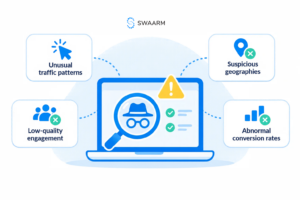
Four signals help you detect affiliate traffic fraud earliest: click-to-install timing, geography consistency, event sequence logic and conversion rate by sub-ID. Each signal compares observed behavior with the pattern a genuine campaign produces. Reviewing the four together is more reliable than reading any single metric alone.
How Does Click-to-Install Timing Show Traffic Quality?
Click-to-install timing measures the gap between an ad click and the first app open or install. Genuine campaigns produce a natural spread of gaps shaped by download speed and user intent. Teams chart the distribution per source and review clusters that sit far outside the campaign’s usual range.
In practice, teams chart the distribution by hour and compare each sub-ID with the campaign median before adjusting caps.
How Does Event Sequence Logic Confirm Quality?
Event sequence logic confirms quality by checking that events occur in a believable order and timeframe. A registration_complete event should precede first_deposit, and level progression should take realistic play time. Sequence rules show that each reward reflects real progression through the funnel.
A common configuration choice is a minimum elapsed time between two events, set per offer and based on the product’s real onboarding speed.
How Do You Detect Affiliate Traffic Fraud in 6 Steps?
Detect affiliate traffic fraud in six steps: define valuable events, pass a unique click ID, configure server-to-server postbacks, build source-level reports, set review thresholds and hold payouts until events pass validation. Each step is short, repeatable and reusable across campaigns and partners.
- Define the events that signal value, such as registration_complete or first_deposit.
- Pass a unique click ID on every partner link.
- Configure S2S postbacks that return the click ID with each event.
- Build weekly reports by partner and sub-ID.
- Set review thresholds for timing, conversion rate and event order.
- Hold payouts until events pass validation.
Consider a illustrative scenario where a mobile game app marketer plans a holiday-season push through six affiliate partners and wants to find which partners bring players who reach level_10_reached. The marketer passes a unique click ID on each partner link and configures S2S postbacks for install, registration_complete and level_10_reached. Each week, the marketer reviews event rate and click-to-install timing by partner and sub-ID in Swaarm reporting, alongside CPA and D7 retention from the game’s analytics. Partners whose players reach level_10_reached at a steady rate receive higher caps, and a new level_5_reached milestone event is added so optimization data arrives sooner.
What Does It Take to Detect Affiliate Traffic Fraud at Scale?
It takes four building blocks to detect affiliate traffic fraud at scale: unique click IDs, server-to-server postbacks, defined multi-event funnels and automated reporting by partner. With these four in place, validation runs continuously, and teams review exceptions instead of every single conversion.
Swaarm’s event tracking and offer management let teams configure events on each offer, with a Swaarm event ID and name, a matching advertiser event ID and a postback URL per event. Payouts and budgets are set at event level, so the same validation setup applies per offer and per event.
A diagnostic example shows how these building blocks work together when one partner’s numbers suddenly look exceptional.
Consider a illustrative scenario where a UA manager at a subscription app reviews weekly affiliate reports and sees one partner’s trial_started conversions double while its click volume stays steady. At first glance, the partner looks like the campaign’s strongest performer. The manager opens Swaarm’s Explorer and Conversion Report to compare click-to-conversion timing, sub-ID mix and onboarding_complete rate for that partner against other sources, alongside CPA. Conversion times cluster far shorter than the campaign norm, and fewer trial_started users reach onboarding_complete. These patterns do not prove fraud, but they justify a closer review. The manager holds the partner’s cap, sets that partner’s conversions on the offer to Pending while the data is reviewed, and agrees to raise the cap once downstream events track conversion volume.
Comparing conversion timing, traffic sources and downstream user behavior lets teams detect affiliate traffic fraud signals before allocating additional budget.
How Do Postbacks and Click IDs Support Validation?
Click IDs and S2S postbacks support validation by linking each conversion to the exact click that produced it. When the advertiser’s server returns the click ID with an event, the platform matches it to the source, timing and payout. Unmatched or duplicate IDs stand out immediately.
How Can Programs Stay Sustainable as Spend Grows?
Programs stay sustainable by pairing growth with quality controls that scale at the same pace. Reward rules, event validation and review thresholds protect payouts while budgets increase. Quality control becomes more valuable as spend rises, because accurate data keeps optimization decisions and partner relationships healthy.
Programs that detect affiliate traffic fraud in layers keep growth on track. According to the Media Rating Council (2020), invalid traffic falls into general and sophisticated categories: routine filtration handles the first, and the second needs deeper analysis across several data points (IAB: MRC IVT guidelines). Affiliate programs apply the same layering, with baseline rules first and pattern review by source second.
Practical controls include:
- Event validation rules, such as a minimum time between registration_complete and first_deposit.
- Payout holds until a postback matches a recorded click ID.
- Review thresholds by sub-ID for conversion rate and timing.
- A regular partner review that shares findings and agrees improvements.
Swaarm’s fraud prevention helps protect that growth as volume increases. The manager configures the advertiser’s server to return the click ID in an S2S postback whenever a deposit clears, and uses Swaarm’s Postback Status optimization rules so conversions that fail checks, such as a duplicated click ID or an invalid security token, are rejected or set to Pending instead of Approved.
How Does Swaarm Help You Detect Affiliate Traffic Fraud From Acquire to Optimize?
Swaarm helps teams detect affiliate traffic fraud across six stages: Acquire, Track, Validate, Reward, Analyze and Optimize. Swaarm Perform covers affiliate tracking, Swaarm MMP covers mobile measurement, and fraud prevention and reporting help teams validate events before rewarding partners and adjusting campaign budgets across the funnel.
- Acquire: Offer management lets networks and advertisers publish offers and assign partners.
- Track: Event-level tracking records meaningful user actions, including S2S postbacks tied to click IDs.
- Validate: Fraud prevention reviews traffic quality before events are rewarded.
- Reward: Rewarded tracking links partner payouts to approved events.
- Analyze: Reporting across campaigns, partners and events shows CPA, event rate and approval rate together.
- Optimize: Performance insights guide budget shifts and offer changes.
Detect Affiliate Traffic Fraud: Building Value Beyond the Click
Valuable affiliate traffic is defined by what users do after the click: the registrations, deposits, purchases and milestones that show real engagement. Teams that detect affiliate traffic fraud make those actions measurable and keep payouts tied to them. A sustainable program needs a clear reward strategy, accurate event tracking and continuous optimization. Swaarm helps teams manage and measure that journey with event tracking, validation and reporting in one platform.
Ready to make every user action count?
Frequently Asked Questions
What signals show whether affiliate traffic is high quality?
High-quality affiliate traffic shows natural click-to-install timing, geography that matches the campaign target, events that follow a believable order and steady conversion rates across sub-IDs. Sources that sit far outside these patterns deserve a closer review before more budget or payouts are assigned.
How can i protect campaign roi from invalid traffic?
Protect campaign ROI by validating events before paying for them. Use unique click IDs, S2S postbacks and payout holds, then monitor CPA, ROAS and event rates by partner. Aligning with Media Rating Council invalid traffic guidance gives teams a recognized layered approach: routine filtration first, deeper pattern analysis second.
What should an affiliate tracking platform validate before paying out?
An affiliate tracking platform should validate that each conversion matches a recorded click ID, arrives within an expected time window, follows the correct event order and comes from the targeted geography. Duplicate or unmatched postbacks should be flagged, and payouts released only after the conversion passes these checks.
How do postbacks help verify affiliate conversions?
Server-to-server postbacks help verify conversions because the advertiser’s server reports the event directly to the tracking platform with the original click ID. The platform matches that ID to the partner, source and timestamp, confirming the conversion happened and attributing it correctly, independent of the user’s browser or device.