Offerwall performance determines whether rewarded user acquisition turns into engaged, active users in 2026. Offerwall performance is the measurable return an offerwall delivers: the share of users who start offers, complete milestone events and keep engaging after the reward.
This guide answers three questions. What makes a rewarded user valuable? How can advertisers and marketers encourage and measure that value? How can the right technology help maximize it? Advertisers, app marketers, publishers and networks can use the answers to improve offerwall results at every stage. As of November 2026, rewarded UA sits alongside traditional paid UA as an established way to reach users who take real actions in an app.
To improve offerwall performance, reward meaningful in-app events instead of installs alone, pass a click ID on every offer click, track each milestone through server-to-server postbacks, and review results by event, source and cohort. Then adjust payouts and offers weekly based on deep-funnel event rates and ROAS.
Key takeaways
- Offerwall performance measures how many users start offers, reach milestone events and keep engaging after the reward.
- Rewarded user acquisition pays for in-app actions, so every offer can be tied to an event you can track.
- Server-to-server postbacks and click ID passing match each reward to the correct user and campaign.
- Swaarm connects tracking, reporting and offer management so teams can optimize each stage of the rewarded journey.
What Is Offerwall Performance and Why Does It Matter in 2026?
Offerwall performance is how effectively an offerwall turns offers into completed in-app events, engaged users and measurable return. It covers offer views, starts, completions, deep-funnel event rates and ROAS. In 2026, offerwall performance matters because advertisers, publishers and networks all use it to decide where to invest in rewarded user acquisition.
An offerwall is a screen inside an app or game where users choose offers, such as installing another app or reaching a level, and earn in-app currency for completing them. Publishers display the offerwall, advertisers supply the offers, and networks or platforms connect the two. Offerwall monetization for publishers and rewarded user acquisition for advertisers are two sides of one flow.
What Makes a Rewarded User Valuable?
A rewarded user is valuable when the in-app action they complete matches a goal the advertiser cares about, such as registration, a first deposit or a level milestone. Value grows as users progress deeper into the funnel and continue engaging after the reward, which is why event depth and retention both matter.
Traditional paid UA follows a path from ad impression to click to install, with in-app events measured afterwards. Rewarded user acquisition follows a path from offer view to offer start to install to milestone event to reward. The difference in journey is what separates the two models: paid UA starts with attention, and rewarded UA starts with an action the user chooses to complete. Both are established and useful.
| Journey element | Traditional paid UA | Rewarded UA (offerwall) |
|---|---|---|
| What drives acquisition | Ad creative and targeting | A clear offer with a defined action and reward |
| Typical conversion event | Install or first open | Install plus one or more milestone events |
| Payout trigger | Install, click or impression | Completed in-app event |
| How progress is measured | In-app events reported after the install | Each milestone tracked as it happens |
Why Is Retention an Important Indicator of User Value?
Retention shows whether users keep returning to an app after completing an offer, so it indicates how much lasting value a rewarded campaign creates. Teams usually read D1, D7 and D30 retention next to deep-funnel event rates to understand which offers and sources bring users who stay engaged. Event-level tracking in Swaarm records each meaningful user action, so teams can compare milestone and retention data by offer, source and cohort.
How Can You Encourage and Measure Offerwall Performance?
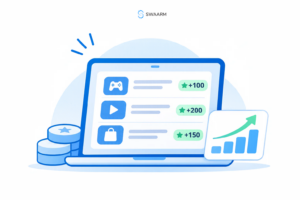
You encourage offerwall performance by rewarding events that reflect real progress, setting clear reward tiers and keeping offers easy to understand. You measure offerwall performance by tracking each event through server-to-server postbacks and reading deep-funnel event rate, retention and ROAS by source. Both steps work together in every rewarded user acquisition campaign.
A simple rewarded flow: offer view → offer start → install → registration → milestone event → reward → analysis. Every arrow is a tracked step that gives the team data to optimize.
How Can Offerwalls Encourage Long-Term Engagement?
Offerwalls encourage long-term engagement when rewards are tied to a sequence of milestones instead of a single action. A multi-step offer, such as registering, reaching level 10 and making a first purchase, guides users deeper into the app and gives teams several measurement points along the way.
Consider a illustrative scenario where a UA manager at a mobile game studio wants more players who reach the mid-game before the Q4 holiday peak. The manager sets up an offerwall offer with three milestones: tutorial_complete, level_10_reached and first_purchase, each with a higher payout than the last. Click IDs are passed on every offer click, and each milestone returns a server-to-server postback. The team reads the deep-funnel event rate for each publisher source, plus D7 retention, in a weekly report. Two sources produce the most level_10_reached events, so the UA manager moves more budget to them and adds a level_20_reached milestone.
Which In-App Events Should an Offerwall Reward?
Reward events that signal real progress: registration_complete, level_10_reached, first_deposit or subscription_started. Choose events that match the advertiser’s goal, appear early enough for users to reach them, and can be validated through a postback. In practice, app marketers often pair a smaller payout for an early event with a larger payout for a deeper event, so the reward rises as the user progresses.
How Do You Run Offerwall Campaigns at Scale?
Running offerwall campaigns at scale needs five building blocks: event-level tracking, multi-event progression, reliable attribution, server-to-server postbacks and consolidated reporting. With these in place, advertisers, publishers and networks can add sources and offers while keeping every reward tied to the right user, event and campaign.
Mobile measurement partners such as AppsFlyer, Adjust, Singular, Kochava and Branch, and tracking platforms such as Everflow and Swaarm, form the category teams review when they build this stack. On iOS, Apple’s AdAttributionKit supports privacy-preserving attribution alongside SKAdNetwork, and ATT requires user permission for tracking. On Android, Google’s Privacy Sandbox documentation describes privacy-preserving measurement APIs. IAB Tech Lab publishes technical standards for digital advertising.
Consider a illustrative scenario where a publisher monetization lead at a casual app studio runs an offerwall that carries offers from several advertisers, including a fintech app and a subscription app. The lead wants to rank offers by value, not only by payout. Each advertiser sends server-to-server postbacks for registration_complete, first_deposit or subscription_started, and the publisher matches each postback to the original offer click by click ID. A single report shows offer completion rate, deep-funnel event rate and revenue per offer. The lead reorders the offerwall so offers with the strongest completion-to-revenue profile appear first, and asks one advertiser to add a mid-funnel event.
How Do You Set Up Offerwall Tracking in 6 Steps?
Setting up offerwall tracking takes six steps: define the goal event, create the offer, pass a click ID, configure postbacks, set payouts and reward logic, then review reports. Following these steps in order keeps every reward linked to a verified user action and gives the team clean data for optimization.
- Define the goal event, such as registration_complete or first_deposit.
- Create the offer with the event, reward and attribution window.
- Pass a unique click ID on every offer click.
- Configure server-to-server postbacks for each milestone event.
- Set payouts and reward logic for each event tier.
- Review reports by offer, source and cohort, then adjust.
Before launch, teams send a test click and confirm that the click ID returns unchanged in the postback.
Which Metrics Show Offerwall Performance at Scale?
Offerwall performance at scale is best read through five metrics: offer start rate, offer completion rate, deep-funnel event rate, D7 retention and ROAS. Reading these metrics by offer, source and cohort shows where to raise payouts, add milestones or shift budget as the program grows.
How Should Teams Read Offerwall Conversion Rate?
Offerwall conversion rate is the share of users who view an offer and then complete the required event. Read it by event depth: deeper milestones ask for more progress, so compare like with like, for example one registration offer against another registration offer.
How Do You Keep Traffic Quality High as Offerwall Programs Grow?
Traffic quality stays high when teams validate rewards against confirmed in-app events and review sources regularly as volume grows. Quality control protects growth by making sure advertisers pay for genuine progress and users receive rewards they earned, which supports long-term trust between advertisers, publishers and networks.
A sustainable program combines a clear reward strategy, accurate event tracking and continuous optimization. As volume grows, reward validation adds one more check: each reward matches a postback from a confirmed event.
How Does Swaarm Support Offerwall Performance at Every Stage?
Technology supports offerwall performance by connecting six stages: acquire, track, validate, reward, analyze and optimize. A platform that links all six lets advertisers, app marketers, publishers and networks see each user action, confirm it, reward it and use the data to improve the next campaign.
Swaarm maps onto the rewarded journey with one capability per stage. Swaarm MMP and Swaarm Perform work together across advertisers, app marketers, publishers and networks.
- Acquire: Swaarm Perform’s offer management lets advertisers and networks set up offers, partners and payouts in one place.
- Track: Swaarm’s event-level tracking records install and milestone events through click ID and postback flows, so each reward matches a real user action.
- Validate: Swaarm’s fraud prevention supports traffic quality and reward validation as programs grow.
- Reward: Swaarm’s rewarded tracking connects payouts to confirmed events, so publishers and networks can reward the milestones advertisers value.
- Analyze: Swaarm’s reporting across campaigns, partners and events shows offerwall performance by offer, source and cohort in one view.
- Optimize: Swaarm’s performance insights help teams raise payouts, add milestones and move budget toward the strongest sources.
Consider a illustrative scenario where an advertiser at an e-commerce app plans a Q4 promotion and wants offerwall users who place a first order. In the Track stage, the marketer uses Swaarm event tracking for app_install, account_created and first_purchase, with a click ID passed on every offer click and a postback returned for each event. In the Optimize stage, the marketer reviews first_purchase rate by publisher and offer, raises the payout for publishers whose users reach first_purchase most often, and tests a new offer variant. Budget moves toward the partners that deliver the strongest first_purchase rate.
Offerwall Performance: Building Value Beyond the Install
Offerwall performance is defined by value: users who complete meaningful events, keep progressing through the app and keep engaging after the reward. Milestones, retention and ROAS show that value clearly, and they give advertisers, publishers and networks a shared way to judge every offer.
A sustainable program needs a clear reward strategy, accurate event tracking and continuous optimization. Swaarm helps teams manage and measure that program through event-level tracking, reporting across campaigns, partners and events, offer management and fraud prevention.
Ready to make every user action count?
Frequently Asked Questions
How do you improve offerwall performance
Improve offerwall performance by rewarding deep-funnel events, using clear reward tiers, passing a click ID on every offer click and reviewing results by offer, source and cohort. Then raise payouts on events that predict engagement and test new offer variants on a regular schedule.
How do you measure the quality of rewarded users
Measure rewarded user quality by combining deep-funnel event rate, D1, D7 and D30 retention, and ROAS for each offer and source. Together these metrics show whether users progress beyond the first reward and whether the campaign returns more value than it costs, which helps teams decide where to invest.
Which metrics matter most for offerwall campaigns
The most useful offerwall metrics are offer start rate, offer completion rate, deep-funnel event rate, D7 retention, ROAS and revenue per offer. Start and completion rates show how appealing offers are, while the deeper metrics show how much value completed offers create for advertisers and publishers.
How does offerwall tracking work with postbacks
Offerwall tracking works by passing a unique click ID when a user starts an offer. When the user completes an event in the app, the advertiser or measurement platform sends a server-to-server postback containing that click ID, and the tracking platform matches it to the offer, source and reward.