Rewarded UA is a user acquisition model in which people earn points, cash or gift cards for completing a defined in-app action. That action can be an install, a level milestone or a first purchase. Done well, it gives advertisers fast access to engaged audiences and a clear way to pay for real progress. This guide follows three questions: what makes a rewarded user valuable, how advertisers can encourage and measure that value, and how the right technology, including Swaarm, helps maximise it.
A valuable rewarded UA user generates more engagement and revenue than acquisition cost plus reward payout. Day-7 retention, deep in-app events and purchases signal that value. Advertisers encourage it with well-designed milestones, measure it with event-level tracking, and optimize it continuously with platforms such as Swaarm.
Key takeaways
- Rewarded UA pays users for verified in-app actions, so aligning payouts with meaningful events ties cost to value.
- A valuable rewarded UA user earns more revenue than acquisition cost plus reward payout within the payback window.
- Day-7 retention and deep-funnel events identify valuable users in rewarded UA better than install volume does.
- Milestone design, tiered rewards and event-level tracking encourage long-term engagement in rewarded campaigns.
- Swaarm RewardOS combines event tracking, MMP integration, offer management, reporting and fraud prevention for rewarded user acquisition.
- iOS measurement of rewarded campaigns relies on SKAdNetwork or AdAttributionKit when users decline App Tracking Transparency.
What is rewarded UA and how does it work?
Rewarded UA is user acquisition that pays users directly, in points, virtual currency, cash or gift cards, for completing advertiser-defined actions. A rewarded app or offerwall shows the offer, the user completes the action, and a server-to-server postback confirms it. The advertiser then pays only for the verified install or event.
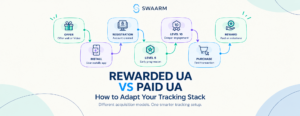
Rewarded campaigns run on a simple loop. An advertiser publishes an offer with a target event. A rewarded app, offerwall or cashback publisher shows that offer to its users. The user installs the app and completes the event. An S2S postback confirms the event, and the publisher releases the reward.
The model goes by several names. Incentivized UA, incentivized installs, rewarded user acquisition and offerwall traffic all describe the same mechanic. What differs is the pricing: CPI, CPE or CPA. Mobile game studios, fintech apps and shopping apps buy rewarded app traffic alongside paid social and network inventory.
According to Playtika’s 2024 Annual Report, as cited in Mistplay’s 2026 mobile advertising trends article, incentivised marketing accounted for more than half of user acquisition activity in certain of the publisher’s games in 2024.
What actually makes a user valuable in rewarded UA?
A user is valuable in rewarded UA when lifetime revenue, net of acquisition cost and reward payout, is positive inside your payback window. In practice, that means the user stays engaged past day 7, completes deep events, monetizes through purchases or ad views, and passes quality checks. Install volume alone does not show any of this.
The formula behind rewarded user value is simple: lifetime value (LTV) minus CPI or CPE minus any reward cost the advertiser funds. Every signal below is a proxy for that number arriving early enough to act on.
Consider a hypothetical campaign. A partner delivers 1,000 installs at a $1.00 CPI, and 50 of those users make a $12 first purchase. Revenue is $600. Paying a $5 CPE for the purchase event would cost $250 for the same 50 users, which ties spend directly to the users who generate value.
Event-level tracking turns that formula into a decision. Swaarm tracks each in-app event and revenue value across the user journey, so advertisers can see which meaningful actions their most valuable users complete, not only who installed. Swaarm RewardOS applies the same event data to rewarded campaigns, from impression to in-app event and reward payout.
Which signals predict a high-value rewarded UA user?
Day-7 retention, completion of tutorial and mid-funnel events, a first purchase or ad interaction within 14 days, and session frequency predict value best. Rewarded cohorts often reveal their quality by day 3. Combine these signals into a simple score instead of relying on one metric such as day-1 retention.
Strong rewarded users usually combine signals. A user who retains and also reaches a monetization event is the profile to scale. Score users on at least one retention signal and one revenue or deep-event signal.
Why is retention an important indicator of user value?
Retention is an important indicator of user value because it shows which users stay engaged after the reward is paid. Users who keep returning on day 7 and day 14 are more likely to reach deeper events and purchases. Compare each rewarded cohort against organic users from your mobile measurement partner (MMP).
Day-1 retention can look healthy because users are still finishing the offer. The clearest picture appears between day 3 and day 14. Read the full retention curve, not a single day.
How do deep-funnel events help identify valuable users?
Deep-funnel events help identify valuable users because they show real engagement and correlate with revenue. Tutorial completion, level thresholds, registrations, first deposits and first purchases each separate committed users from casual ones. An install only proves the app was opened once, so deeper events give a far clearer signal.
Pair a shallow event for an early read with a deep event for payout. For example, track tutorial completion for a day-1 signal and pay partners on level 15 or a first purchase. Swaarm’s rewarded tracking and MMP capabilities let advertisers define these events and return them to partners as postbacks.
How can rewarded UA encourage long-term engagement?
Rewarded UA encourages long-term engagement when the paid milestone reflects real progress inside the app. Place rewards on deeper events, tier payouts across several milestones and tie them to day-N actions. Users then earn rewards for exploring the app rather than finishing a single early task.
Two design choices make the biggest difference. First, spread rewards across the first week instead of the first session, so the reward schedule matches the retention curve. Second, choose events that need real use, not idle time.
A game studio first pays a CPE on level 3, reached in the first session. It then tiers the payouts: a small reward at tutorial completion, a larger reward at level 15 and a bonus for a day-7 purchase. Comparing day-7 retention between the two setups shows how milestone design shapes engagement.
How can advertisers encourage and measure user value in rewarded UA?
Advertisers encourage and measure user value in rewarded UA by designing milestone-based offers, sending every in-app event and revenue value from the MMP back to partners through S2S postbacks, and comparing cohorts by partner and sub-source. Key metrics are retention, event completion rate, CPE, ROAS, LTV and payback period.
As of October 2026, iOS measurement still splits into two paths. Users who grant consent through Apple’s App Tracking Transparency prompt can be attributed at device level. For everyone else, SKAdNetwork returns aggregated, privacy-thresholded postbacks, and Apple’s AdAttributionKit offers a newer privacy-preserving framework from iOS 17.4.
SKAdNetwork 4 adds coarse conversion values and multiple postbacks, but it still limits event-level detail. Map your deep rewarded events to conversion values so the aggregated data still reflects user value. On Android, device-level attribution remains available where users consent under GDPR and CCPA rules.
Reporting is where measurement becomes action. Swaarm gives advertisers visibility into campaigns, partners and events, so they can compare cohorts by partner and event without stitching together separate reports.
How do you set up rewarded UA quality tracking in 6 steps?
You set up quality tracking for rewarded campaigns in six steps: define the value event, map it in your MMP, configure postbacks, hold approvals, build partner cohorts and optimise weekly. Each step turns raw install data into a partner-level view of user value.
- Define the value event that best predicts day-30 revenue.
- Map each milestone in your MMP as a named in-app event with revenue.
- Configure S2S postbacks that return validated events per click ID.
- Hold payout approval until each event passes quality checks.
- Build cohorts by partner and sub-source for retention, event rate and ROAS.
- Review weekly, scale strong sub-sources and adjust payouts as data arrives.
Step 4 protects budgets. A short approval window, such as seven days, lets quality rules and retention checks run before the payout locks. Step 5 shows which sub-sources outperform their partner average, so strong sources can receive more budget.
Which rewarded UA pricing model is better for your campaigns?
The better rewarded UA pricing model depends on your data maturity. CPI suits new apps seeking early volume, CPE suits apps with clear mid-funnel milestones, CPA suits revenue events such as purchases, and ROAS targets suit mature apps with reliable LTV data. Each model moves risk differently.
| Model | You pay for | Best for | Main consideration |
|---|---|---|---|
| CPI | A verified install | New apps seeking early volume | Add deeper events to confirm quality |
| CPE | A specific in-app event | Games with clear milestones | Define events that need real use |
| CPA | A purchase or deposit | Fintech, shopping, subscriptions | Lower volume, higher unit price |
| ROAS target | Revenue against a return goal | Mature apps with reliable LTV | Needs accurate revenue postbacks |
Most advertisers start with CPE and graduate to CPA or ROAS targets as LTV data stabilises. Affiliate networks running rewarded campaigns for several advertisers often keep payout rules per offer, since each advertiser values different events.
Campaign optimization depends on seeing offers, events and performance together. Swaarm’s offer management, event tracking and performance insights let advertisers adjust payouts, caps and partner mix as cohort data arrives.
How can advertisers maintain traffic quality in rewarded UA?
Advertisers maintain traffic quality in rewarded UA by combining bot detection, VPN and proxy checks, event-timing analysis and duplicate-device checks, then reviewing flagged traffic before payout. Clear, automated quality thresholds protect campaign budgets and reward the traffic partners who consistently deliver genuine, engaged users.
Event timing is the most useful signal. Genuine users produce a natural spread of install-to-event times, so clusters of near-identical intervals stand out quickly. Sub-source reports show multi-accounting and emulator patterns early. Enforce quality thresholds automatically, and keep a manual review queue for borderline cases.
Swaarm RewardOS includes an anti-fraud suite with real-time bot detection, abnormal timing recognition, VPN and proxy identification, automated KPI enforcement, and block-and-review workflows. Those controls keep rewarded traffic clean so partner comparisons reflect real user value.
How can the right technology maximize value in rewarded UA?
The right technology maximizes value in rewarded UA by connecting event tracking, reward payouts, fraud prevention and analytics in one workflow. Advertisers then see which users progress, pay for verified actions and optimize partners with data. Swaarm RewardOS and Swaarm MMP are built for this workflow.
Swaarm RewardOS is built for businesses that run their own rewarded app. It integrates natively with an MMP for offer management and combines tracking, rewards, payments, fraud prevention and analytics. Swaarm lists a real-time machine-learning engine that recommends offers to users, plus payouts by gift card, card and bank transfer.
Swaarm Perform serves affiliate networks that need partner-level tracking and payout rules, while Swaarm MMP covers mobile measurement for advertisers. Platforms such as AppsFlyer, Adjust, Singular, Kochava, Branch and Everflow each cover parts of this workflow. The right fit depends on whether you run an advertiser app, a network or your own rewarded app.
What should you check in any platform before running rewarded campaigns?
Before running rewarded campaigns, check that your platform supports event-level data, flexible S2S postbacks, fraud filtering at the event level, sub-source reporting and rule-based payouts. Together these capabilities make partner quality visible and let you reward the traffic that performs.
- Event-level data: every milestone and revenue value, not only installs.
- Postback flexibility: per-partner postback templates and delayed approvals.
- Fraud controls: filtering and holds that act before payout.
- Granular reporting: retention, event rate and ROAS by partner and sub-source.
- Payout logic: rules per offer, event and country.
Rewarded UA: Building value beyond the install
A valuable rewarded user isn’t defined by a single install or completed action. Their value comes from how they engage with an app, progress through meaningful milestones, and contribute to long-term business goals.
With the right reward strategy, accurate event tracking, and continuous optimization, rewarded UA can become an effective part of a sustainable user acquisition strategy.
Swaarm helps businesses manage and measure rewarded acquisition, providing the visibility and tools needed to understand user behavior and optimize campaign performance.
Ready to make every user action count?
Book a demo with Swaarm.
Frequently Asked Questions
Does rewarded ua bring high quality users
Rewarded campaigns bring high-quality users only when the paid event is hard to game and tied to real engagement. Users motivated purely by the reward tend to leave after payout. Tiered rewards, deep events and partner-level cohort reviews raise quality. Quality varies by partner and sub-source, so test small first.
What is the difference between rewarded ua and incentivised installs
Rewarded UA and incentivised installs describe overlapping models. Incentivised installs reward the install itself, while rewarded user acquisition usually covers any reward-linked action, including levels, registrations and purchases. Many networks use the terms interchangeably, so confirm the payable event, install or in-app, before you agree to a campaign.
How do you track rewarded ua on ios after att
Track rewarded UA on iOS by combining device-level attribution for consenting users with SKAdNetwork or AdAttributionKit postbacks for everyone else. Map your deep events to conversion values so aggregated postbacks still reflect user value. Expect less granularity and more delay than on Android, and reconcile partner reports against your MMP.
How much should i pay per event in rewarded ua
Pay less per event than the net revenue an average event completer generates within your payback window. Take expected day-30 revenue per completer, subtract fees and fraud rejection, then divide by your target ROAS. Start there, test with small budgets and adjust payouts weekly by partner.