Amazon Prime Big Deal Days is Amazon’s members-only October sale, and Amazon Prime Big Deal Days Q4 traffic is the early burst of holiday clicks, installs and conversions it sends to affiliate networks weeks before Black Friday. According to PPC Land (2026), Amazon set this year’s event for October 6 and 7, a 48-hour sale across 22 countries.
As of October 2026, the first wave is days away. Here is what network operators, media buyers and UA managers should check first.
Why does Q4 affiliate traffic start increasing before Black Friday?
Short answer: Q4 affiliate traffic rises before Black Friday because Amazon’s October Prime Big Deal Days, rival retailer sales and early gift shopping pull holiday demand forward. Affiliates should audit tracking links, postbacks and caps before October 6, then monitor conversion lag and pre-Black Friday traffic daily through Cyber Monday.
Key takeaways
- Amazon Prime Big Deal Days runs October 6–7, 2026, in 22 countries, making October the first Q4 traffic peak.
- Affiliates and partners drove 19.9% of U.S. online retail sales during Prime Day 2025, per Adobe Analytics.
- S2S postbacks can fail silently under load, so test every postback before October traffic arrives.
- Set caps, payouts and attribution windows before the surge, not during it.
- Incrementality, not click volume, shows whether Q4 spend actually added sales.
Why Does Q4 Affiliate Traffic Start Increasing Before Black Friday?
Q4 affiliate traffic starts increasing before Black Friday because retailers now run deal events in October, shoppers begin gift buying earlier, and advertisers raise budgets to capture that demand. Amazon’s October Prime Big Deal Days acts as the first major trigger, and competing retailers schedule rival sales around it.
Shoppers now treat October as the start of holiday buying. Retail TouchPoints (2025) reported that Adobe forecast $9 billion in U.S. online spend across the two-day fall event, up 6.2% year over year. The same report noted that Walmart, Target and Best Buy run their own deal days that week.
How Big Is the Affiliate Share of Prime Day Sales?
Affiliates and partners accounted for 19.9% of U.S. online retail sales during Prime Day 2025, growing 15% over 2024, according to Adobe Analytics data reported by Digital Commerce 360 (2025). Affiliate and partner channels are a material share of event-week revenue, not a side channel.
Mobile matters too. Digital Commerce 360 (2025) reported that 53.2% of Prime Day 2025 purchases came from mobile devices, so network operators should expect Amazon Prime Big Deal Days Q4 traffic to lean on mobile deep links and app attribution.
How Does Amazon Prime Big Deal Days Q4 Traffic Behave?
Amazon Prime Big Deal Days Q4 traffic arrives in sharp bursts rather than a smooth curve. Deal drops, rival retailer sales and mobile-heavy shopping create short spikes in clicks, followed by delayed conversions. Affiliate networks see volume jump within hours, while confirmed conversions often trail the click peak.
PPC Land (2026) reported that Amazon releases new limited-time deals three times a day during the event. Each release can send a wave of clicks to affiliate links. Plan for peaks measured in hours, not days.
When Does the Q4 Traffic Peak Arrive?
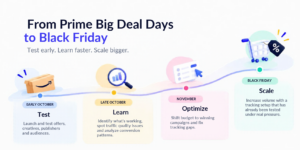
The first Q4 traffic peak arrives when Prime Big Deal Days opens on October 6, 2026. A second peak follows at Black Friday and Cyber Monday in late November. The weeks between give teams time to test offers and fix tracking errors.
One common failure mode is a postback delay at peak volume: dashboards show a profitable source as weak, and an affiliate manager pauses it. Another is a cap that nobody raised after an advertiser approved extra budget, so traffic backs up and publishers move on.
How Do Deal Drops Change Click-to-Conversion Timing?
Deal drops compress click-to-conversion timing for impulse purchases and stretch it for higher-priced items. Shoppers who see a limited-time deal often buy within minutes, while shoppers comparing bigger purchases return later. Networks should report conversions by click hour and by conversion hour to avoid misreading performance.
Conversion lag distorts same-day reports, so use click-date cohorts before cutting any publisher.
How Should Affiliates Prepare for Amazon Prime Big Deal Days and the Q4 Traffic Surge?
Affiliates should prepare for the Q4 traffic surge by auditing tracking links, testing postbacks, confirming caps and payouts with advertisers, and building hourly reporting before October traffic arrives. Finish preparation several days before the event, because tracking errors found mid-surge cost clicks that cannot be recovered.
Amazon Prime Big Deal Days Q4 traffic rewards preparation more than budget: teams with clean links and tested postbacks can scale quickly, while others spend the first day debugging.
What Should Performance Marketers Do Before Black Friday to Capture Early Q4 Traffic?
Performance marketers should lock offers, creatives and landing pages for October, set budgets by day rather than by month, and keep reserve budget for November. Early Q4 traffic rewards teams that test in October and carry only proven sources, creatives and bids into Black Friday and Cyber Monday.
UA managers running CPI or CPE campaigns should confirm SKAdNetwork or AdAttributionKit post back settings on iOS and check Android attribution against Google Privacy Sandbox changes. Teams handling EU or California traffic should confirm that GDPR and CCPA consent flows hold at higher volume.
Media buyers should set a daily CPA or ROAS ceiling for every source before the event starts.
How Do You Set Up Q4 Affiliate Tracking in 6 Steps?
Set up Q4 affiliate tracking in six steps: audit links, test postbacks, set caps and payouts, align attribution windows, build hourly dashboards and review quality daily. Each step targets a common surge failure, such as lost conversions, duplicate postbacks or runaway spend.
- Audit every tracking link. Click each link and confirm the redirect and landing page load.
- Test every S2S postback. Fire a test conversion and confirm the click ID and payout arrive.
- Set caps, payouts and fallbacks. Agree daily caps and backup offers with each advertiser in writing.
- Align attribution windows. Confirm click and view windows with the advertiser before traffic starts.
- Build hourly dashboards. Track clicks, conversions, CPA and ROAS by source, by hour.
- Review quality daily. Check reversals, duplicate click IDs and incrementally.
What Are the Best Ways to Track and Optimise Affiliate Traffic During Q4?
The best way to track affiliate traffic during Q4 is server-to-server postbacks, backed by an attribution layer that matches the advertiser’s model. The best way to optimize is to judge sources by CPA, ROAS, LTV and incrementality, not click volume. Hourly reporting catches problems while budgets are still recoverable.
Each method fails differently under load. The table compares four common approaches.
| Tracking method | Best for | Main Q4 risk |
|---|---|---|
| Server-to-server (S2S) postback | Networks and advertisers that need accurate CPA reporting | Silent failures when the postback URL or macros are wrong |
| Client-side pixel or tag | Fast web checkout tracking | Browser privacy limits and ad blockers drop conversions |
| MMP attribution (AppsFlyer, Adjust, Singular, Kochava, Branch, Swaarm MMP) | App install and in-app event campaigns | iOS signal loss under ATT, SKAdNetwork and AdAttributionKit |
| Affiliate tracking platform (Everflow, Swaarm Perform) | Networks managing many affiliates, caps and payouts | Misconfigured caps or payout rules at scale |
Optimizing Amazon Prime Big Deal Days Q4 traffic is mostly about discipline: pause sources that fail the CPA or ROAS ceiling, scale those that pass, and watch fill rate, since traffic needs a fallback offer once an advertiser hits a cap.
During high-volume periods, keeping traffic, conversion and source-level data in one place makes it easier to see what is driving performance and to react before budgets are wasted. Swaarm Perform shows tracking, revenue and profit numbers in real time for exactly that reason.
How Can Advertisers Manage High-Volume Traffic During Amazon Prime Big Deal Days?
Advertisers can manage high-volume traffic during Amazon Prime Big Deal Days by setting daily caps, defining fallback offers, pre-approving affiliates and monitoring conversion quality hourly. Clear rules agreed before October 6 stop budgets draining on low-quality sources and protect landing page performance during the busiest hours.
Landing pages and checkout flows need load testing, because Amazon Prime Big Deal Days Q4 traffic concentrates clicks into short windows. A slow page wastes every click an affiliate sends. Advertisers should also pre-approve publishers, so unreviewed sources do not appear mid-surge.
Which Caps and Payout Rules Protect Margin During a Surge?
Daily caps per affiliate, overall offer caps and tiered payouts protect margin during a surge. Daily caps stop one source from consuming the whole budget. Tiered payouts reward quality sources. Announce payout changes before traffic starts, because mid-event changes damage affiliate trust and often trigger disputes.
Suppose an advertiser sets a daily offer cap of 1,000 conversions. One affiliate delivers most of that volume by midday, leaving little or no capacity for other publishers. Adding a 250-conversion cap per affiliate prevents a single source from consuming the entire offer cap and helps keep the campaign available across multiple traffic sources.
How Does Swaarm Help Marketers Handle Q4 Traffic Spikes?
Swaarm is an all-in-one performance marketing tracking and attribution platform for affiliate networks and advertisers. Swaarm Perform handles network and affiliate tracking, Swaarm MMP covers mobile measurement, and Search Monetisation supports search traffic. Together they let marketers manage tracking and reporting in one system during Q4 volume spikes.
The value during an October traffic spike is consolidation. A single performance marketing platform reduces the places where a link, postback or payout rule can drift out of sync. Swaarm Perform adds automated rules that change bids and budgets when a campaign hits or misses its KPIs, plus a click and postback shield that filters suspect traffic in real time.
Marketers running app campaigns can add Swaarm MMP for mobile measurement. Swaarm competes with AppsFlyer, Singular, Adjust, Kochava and Everflow, so teams should compare tools against their own traffic mix before choosing.
Bottom line: Amazon Prime Big Deal Days Q4 traffic rewards teams that fix tracking, caps and reporting before the first deal drop. To see how Swaarm handles tracking, postbacks and attribution at Q4 volume, schedule a demo or explore the platform.
Frequently Asked Questions
When is amazon prime big deal days 2026?
Amazon Prime Big Deal Days 2026 runs October 6 and 7, a 48-hour members-only sale in 22 countries, according to PPC Land (2026). Dates and event length vary by country, so international advertisers should confirm local schedules with each advertiser before setting caps and budgets.
How do I stop post backs from failing during high traffic?
Test every S2S postback with a live conversion before the event, then monitor postback receipt hourly. Compare clicks, conversions and payouts between the network and the advertiser each day. Gaps above your normal variance signal a failing postback, a macro error or a rate limit.
what should I track during q4 affiliate campaigns?
Track clicks, conversions by click hour, CPA, ROAS, reversal rate, fill rate and LTV where available. Segment every metric by source and offer. Hourly views catch broken tracking and cap problems quickly, while daily cohort views show true conversion performance once delayed conversions arrive.
What is incrementality and why does it matter in q4?
Incrementality measures the sales or installs a campaign caused, not just those that happened alongside it. In Q4, shoppers buy heavily whether or not an ad ran, so incrementality tests show which affiliate and paid sources truly add conversions and which only claim credit.