Deep-funnel events are the in-app actions that show how far a user has progressed after the install. Deep-funnel events include registrations, completed tutorials, levels reached, first purchases and deposits.
Rewarded UA builds acquisition around deep-funnel events, so advertisers pay for progress and users earn rewards for it. This article answers three questions in order: what makes a deep-funnel event valuable, how advertisers and marketers can encourage and measure deep-funnel events, and how the right technology helps maximise them. Advertisers, app marketers, publishers and networks will each find practical steps.
Deep-funnel events matter because each one shows real progress after the install. Advertisers define the events that signal value, such as a tutorial, a level or a first purchase. Rewarded UA pays for those events, and tracking, attribution and reporting make each one measurable across partners.
Key takeaways
- Deep-funnel events are in-app actions that show user progress beyond the install.
- Rewarded UA ties acquisition cost and user rewards directly to deep-funnel events.
- Milestone design and reward timing shape how engaged users become over time.
- Postbacks and attribution connect each deep-funnel event to the right partner and reward.
- Swaarm tracks, validates and reports deep-funnel events across offers, partners and events.
What are deep-funnel events?
Deep-funnel events are in-app actions that happen after install and show meaningful engagement, such as registration, level completion, subscription start or first purchase. Advertisers choose them because each event reflects progress toward lasting value. App marketers, publishers and networks use them to measure and reward user quality.
An install records that a user arrived. A deep-funnel event records what the user did next. Because the funnel runs from click to install to first open to later milestones, each step further down gives advertisers more evidence about engagement.
Rewarded user acquisition makes those later steps the focus of the campaign. Publishers present the app in a rewards environment, users choose to try it, and advertisers name the deep-funnel events that count. Games, finance apps, shopping apps and subscription services all have natural milestones of this kind.
Swaarm tracks meaningful user actions at the event level, so every deep-funnel event an advertiser defines becomes a measurable data point. With Swaarm MMP’s code-less tracking, marketers set up event tracking from the mobile app through the Swaarm UI, with no code modification.
How do deep-funnel events extend the traditional UA journey?
Deep-funnel events extend the traditional UA journey by adding measured milestones after the install. Traditional UA follows click, install and open. Rewarded UA follows install, deep-funnel event and reward, then continues to deeper milestones. Both models are established, and they differ in where progress is measured.
The two models share infrastructure: attribution, postbacks and reporting. Many advertisers run both, using traditional UA for broad reach and rewarded UA for defined in-app outcomes.
- Traditional UA journey: Ad click → store page → install → first open → optional in-app events.
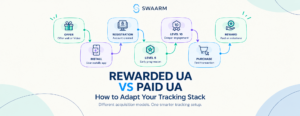
- Rewarded UA journey: Reward offer → install → deep-funnel event → reward → deeper deep-funnel events.
| Dimension | Install-focused UA | Rewarded UA with deep-funnel events |
|---|---|---|
| What drives acquisition | Creative and store listing | Defined in-app tasks with a reward |
| Events typically optimized | Install, registration, purchase | Milestones such as tutorial, level, deposit |
| Progress measurement | Cost per install, then downstream events | Cost per action at each milestone |
| Partners involved | Ad networks, DSPs, publishers | Reward publishers, offer walls, networks |
Swaarm tie-in: Swaarm RewardOS manages offers with native MMP integration, and Swaarm MMP adds attribution for app campaigns on the same platform. Learn more about Swaarm’s mobile measurement partner.
What makes a deep-funnel event valuable in rewarded UA?
A deep-funnel event is valuable when it signals progress that matters to the advertiser’s business. Value is measured in the terms the advertiser already uses, such as ROAS, LTV or CPE. Each completed event moves the user deeper into the funnel and adds evidence about engagement.
A game may value level 10. A finance app may value a verified account. A subscription app may value a completed trial. Naming the deep-funnel events that match the business model is the first step in any rewarded UA campaign.
How can advertisers and marketers encourage and measure deep-funnel events?
Advertisers encourage deep-funnel events by designing milestones that match real product progress, then measuring each milestone as its own event. Clear events, sensible reward timing and consistent reporting show which actions lead to lasting engagement and which partners deliver them.
A repeatable setup for deep-funnel events looks like this:
- Define the target action for the campaign.
- List the milestone events between install and that action.
- Assign a reward to each milestone.
- Configure postbacks for every event.
- Launch with a small set of partners.
- Review event-level results and adjust.
Swaarm RewardOS provides real-time stats, pivots and a custom report builder, so teams can build and analyze their own reports across offers and users.
How can rewarded UA encourage long-term engagement?
Rewarded UA encourages long-term engagement when rewards follow real progress in the app. Deep-funnel events placed along the natural product path guide users toward the features advertisers want them to use, and a sequence of events gives users reasons to return.
A workflow that works well is to start with three to five deep-funnel events, each tied to one product feature. Retention is a useful companion indicator, because it shows whether users keep returning after each milestone. According to adjoe’s 2026 user acquisition guide, 85% of rewarded users in a Fetch case study kept using the app’s core features after engaging with adjoe offerwall games.
Choosing milestone events
Milestone events work best when each one reflects a distinct product action. Examples include completed onboarding, a level reached, a linked payment method or a first purchase. Clear event names help publishers, networks and advertisers read each deep-funnel event the same way.
Setting reward timing and size
Reward timing and size should follow the effort each milestone requires. Early deep-funnel events suit smaller rewards, and later ones suit larger rewards. A staged structure keeps users progressing and lets advertisers adjust payouts per event as results come in.
What does it take to track deep-funnel events at scale?
Tracking deep-funnel events at scale takes four building blocks: event-level tracking, attribution, server-to-server postbacks and reporting. Together they record each milestone, assign it to the right publisher or network, trigger the reward, and show advertisers the result.
Scale also means more partners, more events and more geographies. Standards such as SKAdNetwork and AdAttributionKit shape how iOS conversions are reported, and Google’s Privacy Sandbox does the same on Android. Teams plan their deep-funnel events with those frameworks in mind. Consent rules such as ATT, GDPR and CCPA apply as well.
Swaarm RewardOS manages offers with native MMP integration, from import and configuration to launch, and connects to 150+ demand sources. Automated reconciliation and multi-currency support keep user payments accurate as programs grow.
How do event tracking, attribution and postbacks work together?
Event tracking records each deep-funnel event, attribution assigns it to the traffic source, and an S2S postback tells the partner that the event happened. Together they let advertisers pay accurately per action and let publishers and networks see credited results quickly.
A configuration choice that helps is to name deep-funnel events identically across the MMP, the offer and the partner postback. Matching names keep reporting consistent across AppsFlyer, Adjust, Singular, Kochava, Branch or Swaarm MMP setups.
How does traffic quality protect growth as programs scale?
Traffic quality checks protect growth by confirming that each reward corresponds to a genuine deep-funnel event. As volume rises, reward validation keeps payouts accurate for advertisers, publishers and networks. Validation sits alongside tracking and reporting as a regular part of program operations.
Marketers usually set validation rules once and apply them to every partner. Consistent rules make results comparable across sources.
Swaarm RewardOS includes an anti-fraud suite with automated KPI enforcement and blocking paired with manual review workflows, and Swaarm MMP offers customisable fraud detection for each advertiser’s use case.
How does Swaarm support deep-funnel events?
Swaarm supports deep-funnel events across the full journey: acquire, track, validate, reward, analyze and optimize. Swaarm RewardOS runs the rewarded-app side, from offers to payouts, and Swaarm MMP adds attribution and event measurement. Each stage maps to one Swaarm capability.
Swaarm RewardOS is built for businesses that launch and run their own rewarded app, and it brings offers, users, tracking, rewards, payments, fraud prevention and analytics into one platform. Advertisers, app marketers and networks measure the same deep-funnel events through Swaarm MMP.
Acquire. Swaarm RewardOS imports, configures and launches offers with native MMP integration, and connects to 150+ demand sources. A real-time machine-learning recommendation engine surfaces the right offer to the right user.
Track. Swaarm MMP’s code-less tracking sets up event tracking from the mobile app through the Swaarm UI, so marketers add each deep-funnel event without code changes. Swaarm RewardOS tracks the full user journey from first impression to in-app events and reward payout.
Validate. Swaarm RewardOS applies automated KPI enforcement and automated blocking paired with manual review workflows, so only genuine engagement earns a reward. Swaarm MMP adds customizable fraud detection for each advertiser’s use case.
Reward. Swaarm RewardOS pays users through gift cards, debit or credit cards and bank transfers, with automated scheduling, reconciliation, multi-currency support and real-time balances. According to Swaarm, the Rewards API responds in under 10 milliseconds.
Analyse. Swaarm RewardOS offers real-time stats, pivots, a custom report builder and BI integrations with Tableau and Looker. Swaarm MMP adds Explorer for pivot-table analysis and SQL Studio for custom dashboards. App marketers compare partners, publishers compare offers, and advertisers compare milestones.
Optimise. Swaarm MMP supports customized campaign optimization with rules aligned to advertiser KPIs. Teams refine milestone design and reward levels as data accumulates.
Advertisers get measurable outcomes, publishers get clear attribution for the events they drive, and networks get one operating view across partners.
Deep-Funnel Events: Building value beyond the install
Value in rewarded UA comes from users who complete meaningful actions. Each deep-funnel event shows engagement, and each deeper milestone shows more progress. Advertisers, app marketers, publishers and networks all benefit when those events are defined clearly and measured accurately.
A sustainable program needs a reward strategy, accurate event tracking and continuous optimization. Swaarm helps teams manage and measure deep-funnel events through code-less event tracking in Swaarm MMP, and through end-to-end journey tracking, reporting and fraud prevention in Swaarm RewardOS.
Ready to make every user action count? Book a demo with Swaarm.
Frequently Asked Questions
Why do deep-funnel events matter in mobile marketing?
Deep-funnel events matter because they show what users do after the install. Each event adds evidence about engagement, so advertisers can measure value in terms such as ROAS, LTV or CPE. Publishers and networks benefit too, since clear events make attribution and payouts more accurate.
Which in-app events should I track as deep-funnel events?
Track events that mark real product progress, such as completed onboarding, a level reached, a linked payment method or a first purchase. Choose three to five milestones, tie each to one product feature, and scale rewards with effort. Clear event names keep tracking consistent across partners.
How do I track deep-funnel events?
Track deep-funnel events with event-level tracking, attribution and S2S postbacks. Define each milestone as an event, send it from the app to the tracking platform, attribute it to the source, and post it back to the partner. Matching event names across systems keeps reporting clean.
What is the difference between deep-funnel events and install events?
An install event records that a user downloaded and opened an app. Deep-funnel events record what happens afterward, such as registration, levels or purchases. Both are useful: installs measure reach, and deep-funnel events measure progress. Rewarded UA pays attention to both and rewards the later milestones.