Black Friday marketing in adtech is the practice of planning, running and measuring performance campaigns across the whole holiday-sale window, from early October to Cyber Monday. As of October 2026, Black Friday falls on 27 November, and the campaigns competing for attention that day are already in market. Advertisers, app marketers, publishers and affiliate networks that treat the sale as a season gain more time to test offers, build audiences and measure results.
This article answers three questions in order: What makes an early-season customer valuable? How can advertisers and marketers encourage and measure that value? How can the right technology help maximise it? Readers leave with a phase-by-phase plan, a measurement framework and a clear view of how Swaarm supports each stage.
Black Friday marketing in adtech starts weeks before the sale because audiences, auctions and partner budgets move into holiday mode in October. Marketers who launch phased campaigns, track events from the first click and optimise by phase reach peak week with proven offers and clear, measurable results.
Key takeaways
- Black Friday marketing in adtech covers a season from early October to Cyber Monday, not a single 24-hour sale.
- Phased campaigns give marketers time to test offers, creatives and partners before peak-week budgets go live.
- Event-level tracking shows which early-season actions lead to purchases, sign-ups or deeper in-app engagement.
- Advertisers, app marketers, publishers and networks all benefit from shared, real-time reporting on Black Friday marketing in adtech.
- Swaarm Perform and Swaarm MMP connect offer setup, tracking, validation, reporting and partner payments in one platform.
What is Black Friday marketing in adtech and why does it start early?
Black Friday marketing in adtech is the season-long planning, buying and measurement of performance campaigns around the Black Friday and Cyber Monday sales. It starts early because shoppers browse in October, ad inventory fills with holiday demand, and marketers need weeks of data to choose which offers, channels and partners deserve peak-week budget.
Sensor Tower (2025) puts total ad spend in the Shopping category at $7.6 billion for 2024, and its holiday analysis centers on the October 1 to December 31 window. Logical Position (2024) reports that holiday shopping starts in early November and that consumers expect sales to open early. AppTweak data from 2025, reported by Playio (2026), shows US Apple Ads generic keyword cost per tap at 5.9% above each advertiser’s annual average in October and 8.8% above in November.
Together, these sources show a season that opens before the sale, so preparation for Black Friday marketing in adtech can open early too. Swaarm Perform’s intuitive dashboard shows tracking, revenue and profit in real time, so advertisers and networks can watch the early-season ramp build week by week.
How do single-day and phased-season Black Friday campaigns compare?
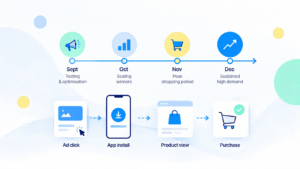
In Black Friday marketing in adtech, a single-day campaign concentrates budget into Black Friday itself, while a phased-season campaign spreads spend across warm-up, pre-sale, peak and post-sale stages. Both models are established and useful. The difference is the journey: phased campaigns add earlier touchpoints, more events to measure and more time to optimise.
The two journeys look like this.
Model A, single-day: ad → click → install or visit → Black Friday purchase.
Model B, phased season: warm-up ad → install or sign-up → early offer → Black Friday purchase → Cyber Week repeat purchase.
| Journey mechanic | Single-day campaign | Phased-season campaign |
|---|---|---|
| Launch window | Final days before Black Friday | October through Cyber Monday |
| Events tracked | Click, install, purchase | Click, install, sign-up, add-to-cart, purchase, repeat purchase |
| Progress measured by | Day-of conversion totals | Phase-by-phase event funnels by partner |
| Budget approach | Concentrated on the peak day | Scaled as each phase proves results |
What makes an early-season customer valuable?
In Black Friday marketing in adtech, an early-season customer is valuable because their actions show intent before the peak. A sign-up, saved basket or first purchase in October tells marketers which offers, creatives and partners attract engaged users. Advertisers use those signals to scale with confidence, and publishers and networks use them to prioritize their strongest placements.
Cost per install (CPI), cost per acquisition (CPA), return on ad spend (ROAS) and lifetime value (LTV) all become easier to forecast when early cohorts are measured event by impact’s 2025 consumer survey of more than 1,000 US shoppers found that 29% begin planning holiday purchases in September and 22% in October, and that 74% buy multiple times across the season.
How can marketers encourage and measure early-season value?
Marketers encourage early-season value in Black Friday marketing in adtech by giving shoppers a reason to act before Black Friday, such as early-access offers, app-only deals and loyalty rewards. They measure that value by tracking every meaningful event, from install to purchase, and comparing results by phase, partner and campaign.
Advertisers set the offers. App marketers define the in-app events that count. Publishers match placements to each phase, and affiliate networks pass partner-level data back to advertisers. In practice, teams create one campaign per phase and put the phase name in the campaign name, so reports can be sliced by warm-up, pre-sale and peak. Swaarm MMP supports code-less event tracking, so marketers can add events such as sign-up or add-to-cart from the Swaarm interface without changing app code.
How do you plan Black Friday marketing in adtech in 6 steps?
Plan Black Friday marketing in adtech by splitting the season into phases, defining the events that matter, setting offers and payouts, testing tracking before launch, reviewing results weekly and shifting budget toward what works. Each step is a short, repeatable action.
- Map the season into warm-up, pre-sale, peak and post-sale phases.
- Define the events that signal value, such as install, sign-up, add-to-cart and purchase.
- Set offers, payouts and budgets for each phase and partner.
- Test every click, postback and event before launch.
- Review phase results weekly across campaigns and partners.
- Move budget toward the offers and sources that reach the next event.
How should marketers measure the warm-up phase?
Measure the warm-up phase by early engagement events: installs, sign-ups, saved items and first purchases. These events show which offers and partners create interest before the sale. Compare CPI and CPA by partner, and use the results to decide where peak-week budget goes.
How should marketers measure the peak phase?
Measure the peak phase by conversion volume, ROAS and revenue per partner, reviewed daily from Black Friday through Cyber Monday. Peak-week reporting answers one question quickly: which campaigns deserve more budget today? Teams configure optimization rules before the sale opens, so agreed changes apply automatically while demand is highest.
What does it take to scale Black Friday campaigns sustainably?
Scaling Black Friday marketing in adtech sustainably takes four building blocks: accurate event tracking, reliable attribution, server-to-server (S2S) postbacks and unified reporting. When those four work together, advertisers, app marketers, publishers and networks can add budget and partners during peak season while keeping results clear and comparable.
Swaarm provides mobile measurement (MMP) and affiliate tracking capabilities, helping advertisers and networks track attribution and measure campaign performance across iOS and Android. Other MMPs include AppsFlyer, Adjust, Singular, Kochava and Branch, while affiliate tracking platforms include Everflow. Privacy frameworks such as ATT, SKAdNetwork, AdAttributionKit, GDPR and CCPA shape how attribution data is collected and measured. Swaarm’s automated optimisation rules apply bid and budget changes when a campaign reaches its KPIs, helping teams scale consistently as daily campaign volume rises.
Why the lowest CPA isn’t always the best choice?
Imagine two Black Friday campaigns generating similar conversion volumes. Campaign A delivers a lower cost per acquisition (CPA), but most customers make only one purchase. Campaign B has a slightly higher CPA, but its customers return for repeat purchases and generate higher lifetime value (LTV).
If marketers evaluate performance based only on acquisition costs, they may scale Campaign A and overlook the long-term value of Campaign B.
By tracking post-conversion events and comparing customer cohorts over time, marketers can understand which campaigns attract customers who deliver lasting value. Consistent attribution and deeper performance reporting help advertisers allocate budgets based on customer quality and long-term returns, not just initial conversion costs.
How do postbacks and event tracking keep Black Friday data accurate?
Server-to-server postbacks send each conversion event from the advertiser’s system to the tracking platform in real time. Paired with event-level tracking, postbacks show which click led to which install, sign-up or purchase, so partner reporting and payouts stay accurate while volume rises through peak week.
Testing one postback per event before launch confirms that values such as revenue and currency pass through correctly. Before launch, teams send a test event for each tracked action, then confirm in the Explorer tool that each one appears under the right campaign and partner.
How does traffic quality protect Black Friday growth?
Traffic quality protects growth in Black Friday marketing in adtech by confirming that every click, install and reward-triggering event comes from a real user and meets the offer’s rules. Validation matters more as Black Friday programs scale, because larger budgets and more partners create more events to review automatically.
Traffic-quality checks work best when set up before the sale. Marketers define acceptance rules per offer, review partner-level event reports and pause sources that fall outside agreed thresholds. Swaarm Perform’s integrated click and postback shield filters events such as impressions and clicks in real time, and Swaarm MMP offers customisable fraud detection and prevention. Together, these controls help advertisers pay for real results and help publishers and networks show the value of their traffic.
How does Swaarm support Black Friday marketing in adtech?
Swaarm supports Black Friday marketing in adtech through Swaarm Perform and Swaarm MMP, which cover the journey from offer setup to partner payment. Advertisers, app marketers, publishers and networks can acquire traffic, track events, validate results, analyze performance and optimize campaigns from one platform.
Swaarm Perform and Swaarm MMP follow the same journey as a phased season: Acquire, Track, Validate, Analyze, Optimize and Pay. Each stage maps to one concrete capability.
- Acquire: The network syncer and automated offer import bring partner offers into Swaarm, and data-driven targeting restricts geo, devices, traffic type and carriers in real time.
- Track: Swaarm MMP’s actionable attribution follows the user journey, and code-less event tracking adds events from the Swaarm interface with no app code changes.
- Validate: The click and postback shield filters events in real time, and Swaarm MMP’s fraud detection and prevention can be customized to each use case.
- Analyze: The Explorer tool sorts and filters millions of events by drag and drop, granular analytics offer 25 dimensions and 20 measures, and Swaarm MMP connects dashboards such as Tableau and Looker.
- Optimize: Automated optimization rules apply bid and budget changes when campaigns reach their KPIs, and can approve offers and switch off sources that are not performing.
- Pay: Automated partner payments generate payouts for every partner from real-time stats, with one-click payment inside Swaarm MMP.
Here is how the six stages apply across a phased season. During warm-up, teams import offers, apply targeting and set up code-less events so tracking is ready before spend ramps. During the pre-sale phase, Explorer and granular analytics show which partners and offers reach the next event, and automated optimization rules scale those winners. During peak week, the click and postback shield and real-time dashboard keep results clean and visible while budgets are at their largest. After Cyber Monday, automated partner payments close the season, and cohort analysis supports re-engagement campaigns. Swaarm Perform and Swaarm MMP use the same event definitions in every phase, which keeps reporting consistent from the first October click to the last Cyber Week purchase.
Because every stage uses the same event data, a phased season stays comparable from warm-up to Cyber Monday. Each role gets a clear view. Advertisers manage partner campaign access, payouts and budgets from one place. App marketers analyze cohorts to plan re-engagement campaigns after the sale. Publishers on CPM models use smart links to show the right advert to the right user. Networks consolidate monthly numbers with partner data for faster billing.
Black Friday marketing in adtech: Building value beyond the sale
Value in Black Friday marketing in adtech comes from the customers reached early, the events they complete and the partners that bring them. A user who installs in October, adds an item in November and purchases in Cyber Week shows how a season builds results beyond a single sale.
A sustainable program needs a clear offer strategy, accurate event tracking and continuous optimization. Swaarm helps advertisers, app marketers, publishers and networks manage and measure each stage, from offer setup to partner payment, in one platform.
Ready to make every user action count?
Frequently Asked Questions
How do i track black friday campaign performance across partners?
Track Black Friday campaign performance across partners by giving each partner a tracking link, sending conversion events through S2S postbacks and reporting everything in one platform. Compare partners by CPA, ROAS and event completion, using the same event definitions for every campaign.
How can affiliate networks prepare for black friday traffic?
Affiliate networks prepare by importing offers early, testing links and postbacks, agreeing payout rules with advertisers and publishers, and setting automated rules for budgets and traffic sources. Early preparation lets networks scale confident partners during peak week and report results to advertisers in real time.
What is the best way to measure black friday ad performance?
Measure Black Friday marketing in adtech phase by phase, using the events that match each goal: installs and sign-ups during warm-up, purchases and ROAS during peak week. Use event-level tracking, consistent attribution windows and one reporting view, so results from every phase stay directly comparable.
How often should i review black friday campaign data?
Review warm-up and pre-sale data weekly, then move to daily reviews from Black Friday through Cyber Monday. Weekly reviews show which offers and partners to scale, and daily reviews let marketers shift budget while demand is highest. Automated rules can apply agreed changes between reviews.